

Zeno Guardini, Rodrigo L. Gomez, Johannes Stuttmann, Parveen Akhtar, Petar H. Lambrev, Luca Dall’Osto, Roberto Bassi
In cell biology textbooks, we learn that chloroplasts are the sites of photosynthesis and that, within them, a membrane system known as the thylakoid network hosts the photosystems—the protein complexes that convert light energy into chemical energy.
It has long been known that thylakoids are not randomly organized. Instead, they form distinct domains: the grana, which are regions of stacked membranes, and the stroma lamellae, which connect the grana to one another. We also know that thylakoids display so-called lateral heterogeneity: Photosystem II is located in the grana, whereas Photosystem I is found mainly in the stroma lamellae.
The structural and functional basis of this separation has long been hypothesized, but had not yet been fully demonstrated.
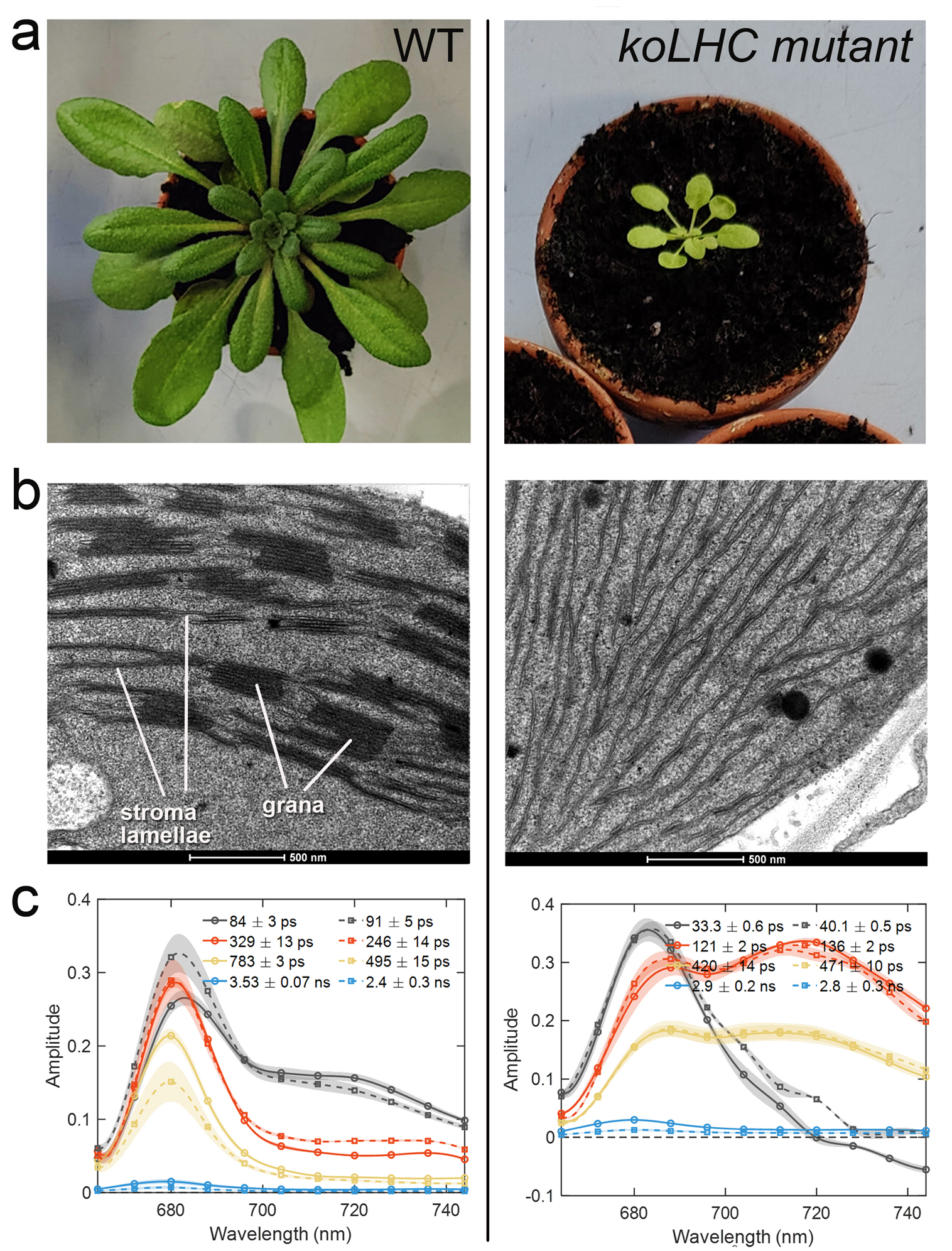
In a study recently published in The Plant Cell, the Laboratory of Photosynthesis and Bioenergetics showed that Photosystem II antenna proteins play a key role in thylakoid organization. These proteins promote grana formation by acting as a kind of “molecular glue” and are essential for keeping the photosystems separated within their respective domains.
The study’s findings indicate that this separation serves an important physiological function: it optimizes light-driven electron flow. The organization of thylakoids into grana and stroma lamellae prevents the photosystems from mixing, thereby avoiding the formation of actual “short circuits” in electron transport.
In mutants lacking antenna proteins, these short circuits occur much more frequently and significantly impair the production of ATP and NADPH, the energy-rich molecules that are essential for photosynthesis. As a result, plant growth is also severely reduced.
In summary, the study demonstrates that the internal architecture of chloroplasts is not merely a morphological detail: it is essential for the proper functioning of photosynthesis.
These discoveries could open up new opportunities for improving agricultural crops. Increasing crop productivity will require more efficient electron transport during photosynthesis while minimizing the potential “short circuits” that limit photosynthetic efficiency.
The study was conducted at the University of Verona by Zeno Guardini, Rodrigo L. Gomez, Roberto Bassi, and Luca Dall’Osto, with contributions from Petar H. Lambrev and Parveen Akhtar of the HUN-REN Biological Research Centre in Hungary, and Johannes Stuttmann of Martin Luther University Halle-Wittenberg in Germany.
Figure legend:
(a) Comparison of the phenotypes of wild type (WT) and mutant plants.
(b) Transmission electron microscopy images of chloroplasts.
(c) Analysis of the degree of “mixing” between the two photosystems using time-resolved fluorescence spectroscopy.


